
Opening Scene
A power substation runs continuously, monitored and maintained by the utility itself, with individual customers never having to think about its upkeep, patching, or physical security. A cloud data warehouse offers this same fully managed operational model: the platform provider handles the underlying infrastructure’s maintenance, patching, and continuous availability, so the organization using it doesn’t have to.
In Plain English
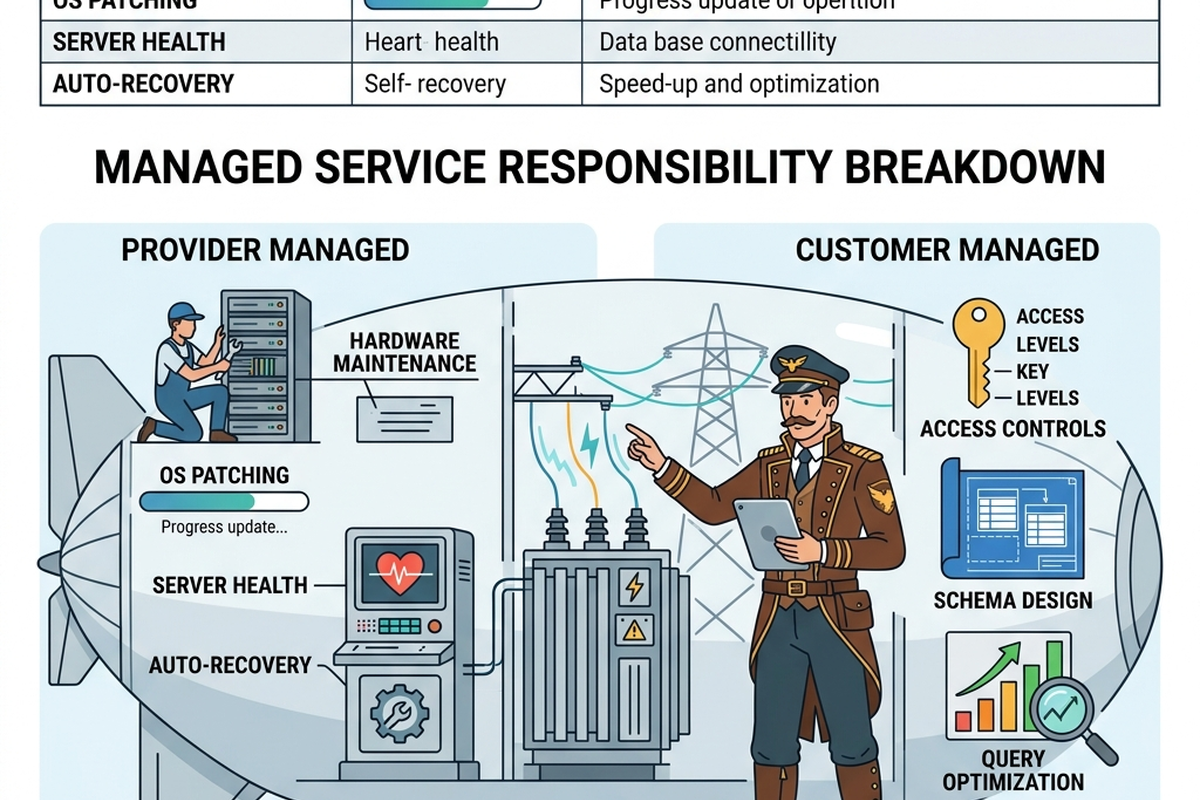
A fully managed service shifts operational responsibility for infrastructure maintenance, software patching, and underlying hardware failures away from the organization using the warehouse and onto the cloud provider. This is a genuinely different operational model from self-managed, on-premises infrastructure, and understanding exactly what shifts — and what doesn’t — is essential to using a cloud data warehouse well, since some responsibilities, like access control and query optimization, remain genuinely the customer’s own.
The Old Way
Before fully managed cloud data warehouse services existed, this operational burden fell entirely on the organization using the warehouse:
- Organizations had to maintain dedicated staff for patching, hardware maintenance, and infrastructure monitoring, a significant, ongoing operational cost.
- Infrastructure failures required the organization’s own team to diagnose and resolve issues, often under real time pressure.
- There wasn’t yet a well-established practice of shifting this specific operational burden to a specialized third-party provider for data warehouse infrastructure.
The fully managed model emerged specifically to shift this operational burden to providers genuinely specialized in running this infrastructure reliably at scale, freeing organizational resources for other work.
What’s Changing (and Why AI Is the Reason)
- Cloud data warehouse providers increasingly handle infrastructure maintenance and patching directly, connecting directly to the broader managed-service shift covered throughout this content library’s Cloud & Modern Data Platforms category.
- This connects directly to the governance considerations covered in Article 17, since understanding exactly which responsibilities remain the customer’s own — access control, data governance — is essential even under a fully managed model.
- As this model has matured, organizations increasingly redirect infrastructure operations staff toward higher-value data and analytics work.
The Metaphor, Fully Extended
| The Utility Grid | Fully Managed Service Concept |
|---|---|
| A substation running continuously, maintained by the utility | Infrastructure running continuously, maintained by the cloud provider |
| Customers never having to think about physical upkeep | Organizations not having to manage physical or virtualized hardware directly |
| A genuinely different operational model from self-generation | A genuinely different operational model from self-managed infrastructure |
| Some responsibilities still remaining genuinely the customer’s own | Some responsibilities — access control, query optimization — remaining genuinely the customer’s own |
For Beginners: What to Actually Do
- Practice mapping out exactly which responsibilities shift to your cloud data warehouse provider and which remain your own.
- Learn to recognize the fully managed model as a genuine operational shift, not just a marketing term.
- Get comfortable exploring what specific maintenance and patching tasks your provider handles automatically.
For Practitioners and Leaders: The Deeper Layer
- Clearly document which operational responsibilities shift to your cloud provider and which remain internal, avoiding gaps in coverage.
- Recognize the fully managed model as freeing organizational resources for higher-value data and analytics work.
- Connect remaining internal responsibilities directly to the governance considerations covered in Article 17.
Quick Recap
- A fully managed service shifts infrastructure maintenance and patching responsibility to the cloud provider.
- This is a genuinely different operational model from self-managed, on-premises infrastructure.
- Some responsibilities, like access control and query optimization, remain genuinely the customer’s own.
- This shift frees organizational resources for higher-value data and analytics work.
Where This Fits in the Series
Article 6 covered the fully managed service model. Article 7 turns to wiring the house for the grid: the practical migration path from on-premises to cloud.
Key References
- Snowflake Documentation — Comprehensive technical documentation for cloud-native data warehousing.
- Google Cloud BigQuery Architecture Overview — Scalable serverless cloud database specifications.
- AWS Redshift Database Developer Guide — Amazon Web Services cloud data warehouse documentation.
Subscribe to the Newsletter
Get the latest DataParables articles delivered straight to your inbox.