
Opening Scene
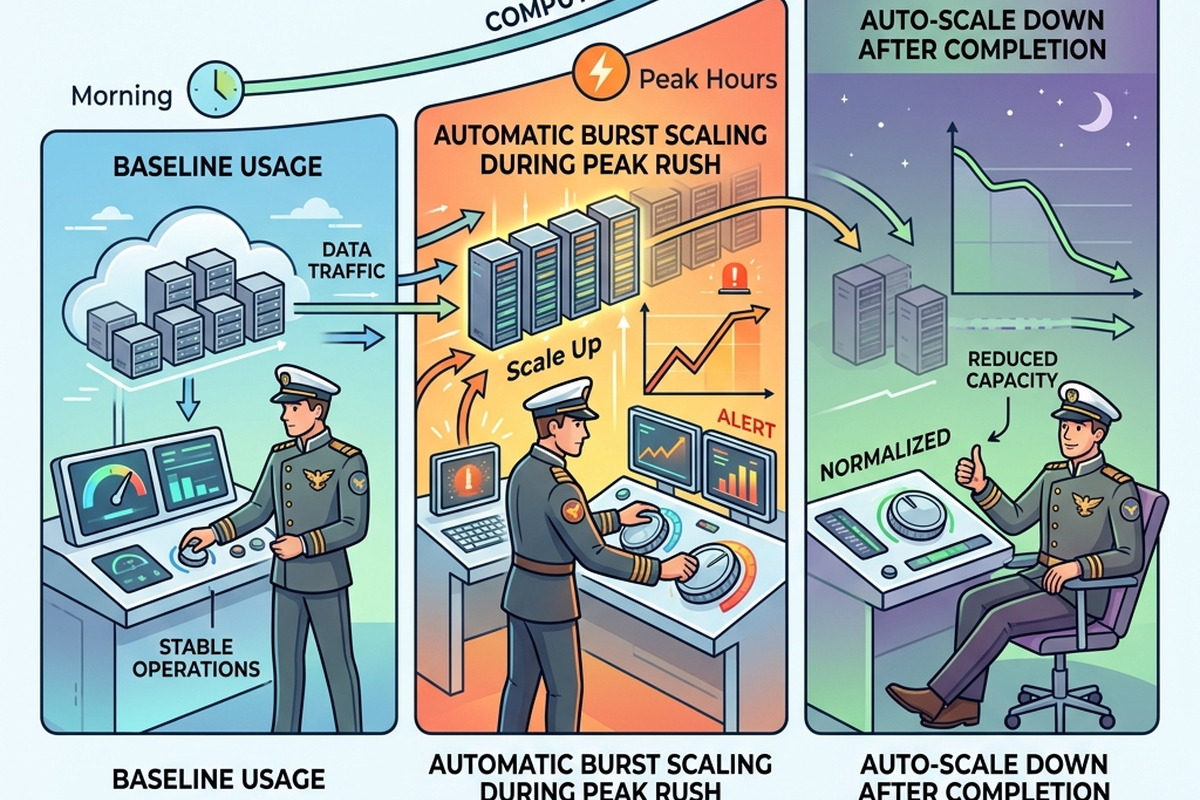
A well-run grid handles a sweltering summer afternoon’s peak air-conditioning demand by drawing on additional generation capacity temporarily, then scaling back down once demand subsides — no permanent new power plant required for a temporary spike. Cloud data warehouses offer this exact same elastic capability: compute capacity that scales up temporarily for genuine peak demand, then scales back down once it passes.
In Plain English
Elastic scaling lets a cloud data warehouse’s compute capacity increase automatically or on request during periods of high demand — a month-end reporting rush, a large batch job, an unexpected surge in analytical queries — and then decrease again once that demand subsides, with billing that tracks this actual usage pattern directly. This directly extends the storage-compute separation covered in Article 4, since it’s specifically the compute layer that scales this elastically.
The Old Way
Before elastic scaling was a mature, practical capability, handling variable demand required real, uncomfortable compromises:
- Organizations had to provision fixed warehouse capacity sized for their expected peak demand, sitting significantly underutilized most of the rest of the time.
- Alternatively, some organizations under-provisioned for cost reasons, accepting real, uncomfortable performance degradation during genuine peak periods.
- There wasn’t yet a well-established, practical way to scale compute capacity temporarily and automatically, matching actual real-time demand.
Elastic scaling emerged specifically to eliminate this uncomfortable tradeoff, letting compute capacity track actual demand directly rather than requiring a fixed, compromise-driven provisioning decision.
What’s Changing (and Why AI Is the Reason)
- Cloud data warehouses increasingly support automatic, granular elastic scaling, connecting directly to the storage-compute separation covered in Article 4 that makes this possible.
- This connects directly to the cost awareness covered in Article 9, since elastic scaling only delivers genuine savings if it’s actually configured to scale down during idle periods, not just up during peaks.
- As AI-driven analytical workloads have grown increasingly spiky and unpredictable, elastic scaling has become genuinely essential to handling this variability economically.
The Metaphor, Fully Extended
| The Utility Grid | Elastic Scaling Concept |
|---|---|
| Drawing on additional generation temporarily during peak demand | Scaling compute capacity up temporarily during peak query demand |
| Scaling back down once demand subsides | Scaling compute capacity back down once demand subsides |
| No permanent new power plant required for a temporary spike | No permanent additional infrastructure required for a temporary workload |
| Billing that tracks actual usage, not fixed peak capacity | Billing that tracks actual compute usage, not fixed provisioned capacity |
For Beginners: What to Actually Do
- Practice configuring elastic scaling settings for a real or test cloud data warehouse workload, observing how compute capacity responds to demand.
- Learn to distinguish elastic scaling that only scales up from elastic scaling that also reliably scales back down.
- Get comfortable monitoring how well your organization’s actual scaling configuration matches genuine demand patterns.
For Practitioners and Leaders: The Deeper Layer
- Evaluate whether your organization’s elastic scaling configuration genuinely scales down during idle periods, not just up during peaks, connecting directly to the cost awareness covered in Article 9.
- Recognize elastic scaling as increasingly essential for handling AI-driven, unpredictable analytical workload patterns.
- Track scaling behavior over time to identify whether configured thresholds still match actual, evolving demand patterns.
Quick Recap
- Elastic scaling lets compute capacity increase and decrease automatically to match genuine, real-time demand.
- This directly extends the storage-compute separation covered in Article 4.
- Genuine savings require scaling down during idle periods, not just scaling up during peaks.
- This has become increasingly essential for handling spiky, AI-driven analytical workloads economically.
Where This Fits in the Series
Article 5 covered elastic scaling for peak demand. Article 6 turns to the substation that never sleeps: the always-on availability of a managed cloud warehouse service.
Key References
- Snowflake Documentation — Comprehensive technical documentation for cloud-native data warehousing.
- Google Cloud BigQuery Architecture Overview — Scalable serverless cloud database specifications.
- AWS Redshift Database Developer Guide — Amazon Web Services cloud data warehouse documentation.
Subscribe to the Newsletter
Get the latest DataParables articles delivered straight to your inbox.