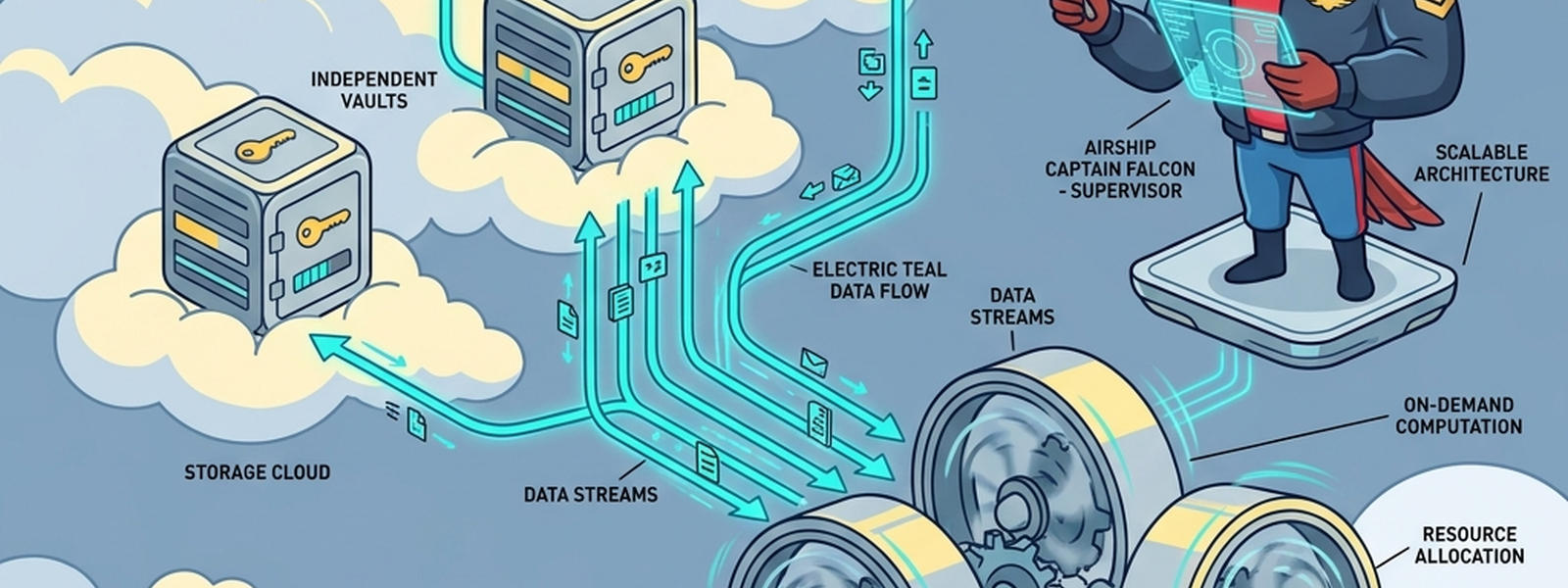
Opening Scene
A utility that metered electricity and water together, as one undifferentiated resource, would make it genuinely hard to manage either well — you couldn’t cut your water bill without also cutting power, even if power was the resource you weren’t actually overusing. Cloud data warehouses avoid this exact same problem by deliberately decoupling storage from compute, letting each scale and cost independently.
In Plain English
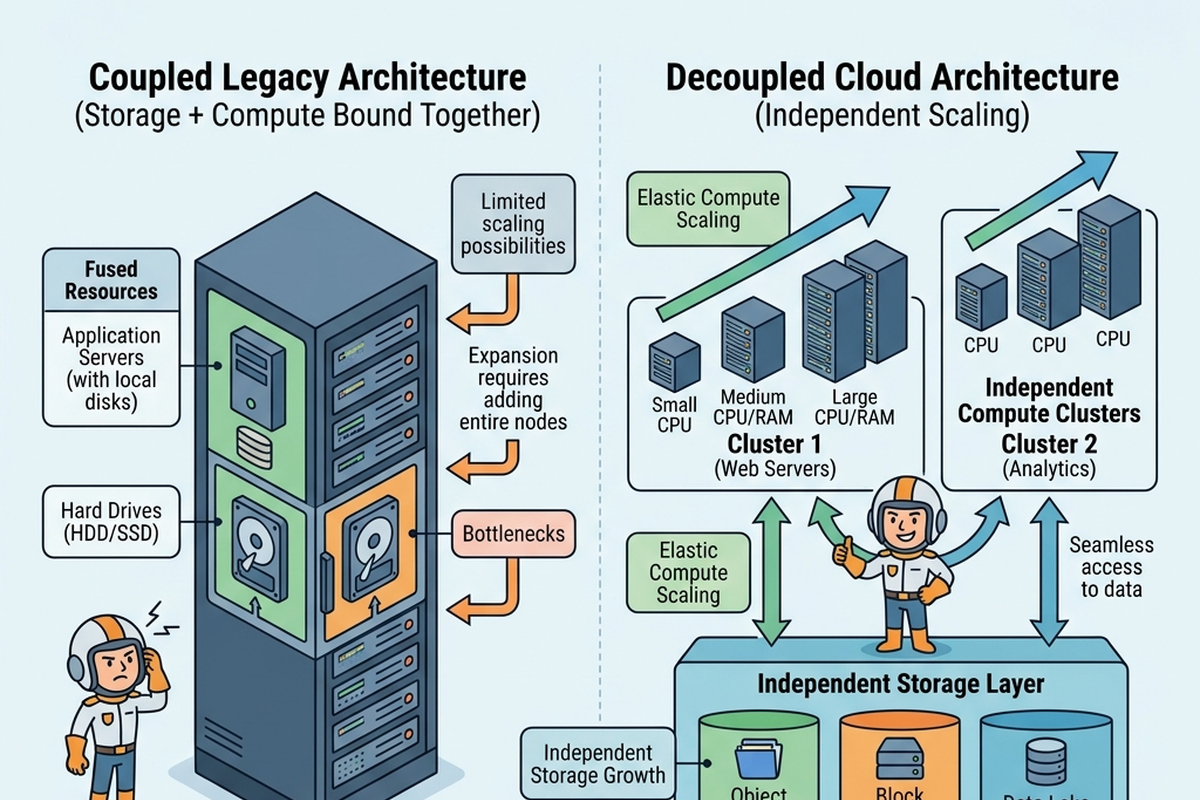
Storage-compute separation means a cloud data warehouse’s storage layer (where data actually sits) and compute layer (the processing power that runs queries against that data) can scale independently of each other. This is a genuinely significant architectural shift from earlier data warehouse designs, where storage and compute were tightly coupled within the same hardware, meaning you had to scale both together even if you only needed more of one.
The Old Way
Before storage-compute separation was standard architecture, earlier data warehouse designs coupled the two resources together:
- Earlier data warehouse architectures typically bundled storage and compute within the same physical hardware, meaning scaling one required scaling the other, even when only one was genuinely the bottleneck.
- This coupling meant organizations often over-provisioned compute just to get enough storage, or vice versa, since the two couldn’t be sized independently.
- There wasn’t yet a well-established architectural pattern for separating these two genuinely distinct resources cleanly.
Storage-compute separation emerged specifically to solve this coupling problem, allowing each resource to be sized, scaled, and billed according to its own genuine, independent needs.
What’s Changing (and Why AI Is the Reason)
- Cloud data warehouses increasingly architect storage and compute as genuinely independent, separately scalable layers, connecting directly to the elastic scaling covered in Article 5.
- This connects directly to the multi-tenancy and workload isolation covered in Article 11, since separated compute layers can be spun up independently for different teams or workloads without contention.
- As this architecture has matured, organizations increasingly pause or scale down compute entirely during idle periods while storage persists unaffected, a pattern covered fully in Article 9.
The Metaphor, Fully Extended
| The Utility Grid | Storage-Compute Separation Concept |
|---|---|
| Electricity and water metered as genuinely separate resources | Storage and compute billed as genuinely separate resources |
| Being able to manage one without being forced to scale the other | Being able to scale compute without being forced to also scale storage |
| Avoiding waste from bundled, undifferentiated metering | Avoiding waste from bundled, tightly coupled hardware |
| Each resource sized according to its own genuine need | Each resource sized according to its own genuine, independent need |
For Beginners: What to Actually Do
- Practice identifying, for a real workload, whether storage or compute is actually the genuine bottleneck before assuming both need scaling together.
- Learn to recognize storage-compute separation as a genuinely significant architectural shift, not just a billing detail.
- Get comfortable exploring how your specific cloud data warehouse platform implements this separation.
For Practitioners and Leaders: The Deeper Layer
- Evaluate whether your organization is taking full advantage of independent storage and compute scaling, rather than scaling both together out of habit.
- Connect storage-compute separation directly to the elastic scaling practices covered in Article 5 and the multi-tenancy patterns covered in Article 11.
- Recognize this architectural pattern as foundational to nearly every other capability covered throughout this series.
Quick Recap
- Storage-compute separation lets a cloud data warehouse’s storage and compute layers scale independently.
- This is a genuinely significant architectural shift from earlier, tightly coupled warehouse designs.
- Independent scaling avoids the waste of having to over-provision one resource just to get enough of the other.
- This architecture is foundational to elastic scaling, workload isolation, and cost optimization covered throughout this series.
Where This Fits in the Series
Article 4 covered storage-compute separation as the foundational architecture. Article 5 turns to what this architecture actually enables: turning the dial up during peak demand.
Key References
- Snowflake Documentation — Comprehensive technical documentation for cloud-native data warehousing.
- Google Cloud BigQuery Architecture Overview — Scalable serverless cloud database specifications.
- AWS Redshift Database Developer Guide — Amazon Web Services cloud data warehouse documentation.
Subscribe to the Newsletter
Get the latest DataParables articles delivered straight to your inbox.