
Opening Scene
Before electrical grids connected entire regions, every factory that needed power essentially fended for itself, building and maintaining its own generation capacity, sized as a best guess for future need. Organizations provisioning their own on-premises data warehouse faced this same essentially isolated challenge before cloud data warehouses existed as a mature, practical alternative.
In Plain English
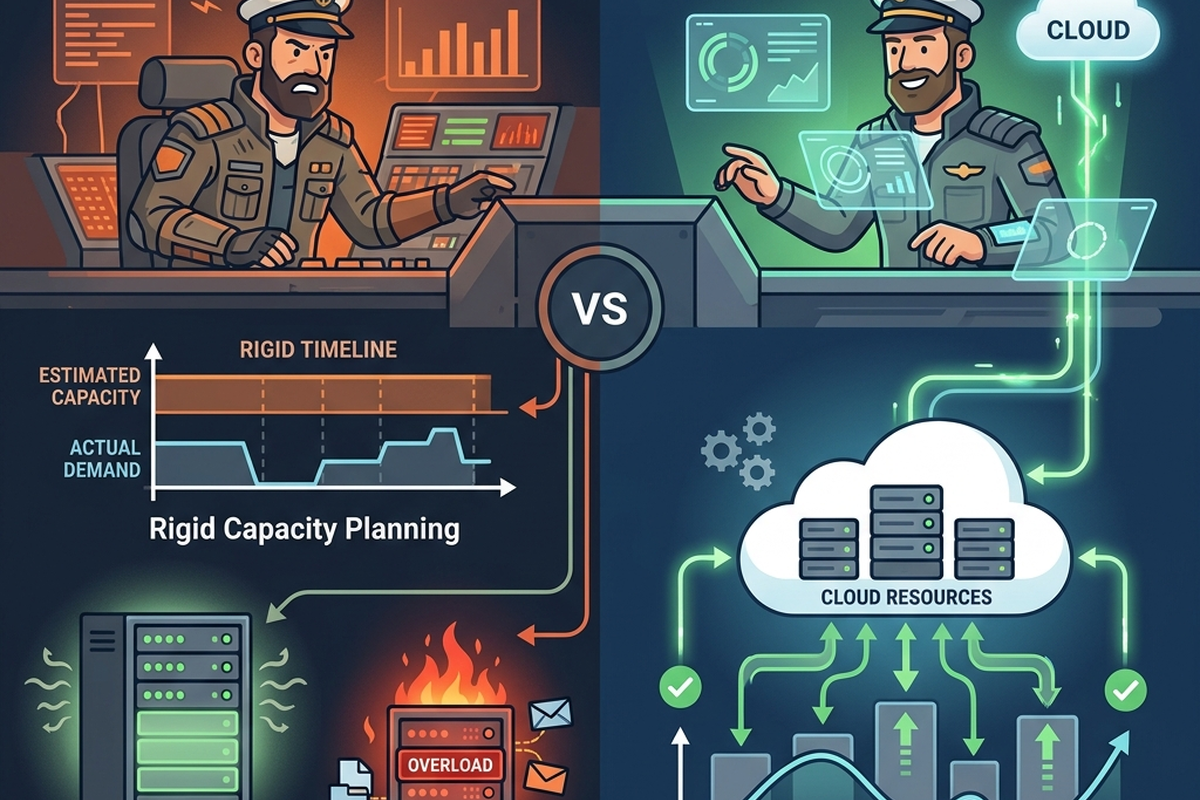
Before cloud data warehouses matured, organizations had to purchase physical or virtualized warehouse hardware, size it based on projected future demand, and manage its ongoing operation, patching, and capacity planning entirely themselves. Getting this sizing wrong in either direction was genuinely costly: under-provisioning caused real performance problems during peak demand, while over-provisioning meant paying for capacity that sat idle most of the time.
The Old Way
Before cloud data warehouses existed, this provisioning challenge created real, recurring organizational friction:
- Organizations had to project future data warehouse capacity needs years in advance, a genuinely difficult and often inaccurate exercise.
- Scaling up required a slow, capital-intensive hardware procurement and provisioning cycle, unable to respond quickly to sudden, unexpected demand.
- Dedicated infrastructure teams were often required just to operate, patch, and maintain the warehouse hardware itself, separate from the actual data and analytics work it existed to support.
Cloud data warehouses emerged specifically to close this gap, replacing difficult, upfront capacity projection with genuinely elastic, on-demand provisioning.
What’s Changing (and Why AI Is the Reason)
- Cloud data warehouses have replaced difficult, upfront capacity planning with the elastic scaling covered fully in Article 5, fundamentally reducing this historical risk.
- This connects directly to the broader shift away from dedicated infrastructure operations covered throughout this content library’s Cloud & Modern Data Platforms category.
- As this shift has matured, organizations increasingly redirect resources previously spent on infrastructure operation toward data and analytics work itself.
The Metaphor, Fully Extended
| The Utility Grid | Warehouse Provisioning Before the Cloud |
|---|---|
| Every factory building and maintaining its own generation capacity | Every organization purchasing and operating its own warehouse hardware |
| Sizing generation capacity as a best guess for future need | Projecting future warehouse capacity years in advance |
| A slow, capital-intensive process to scale up generation | A slow, capital-intensive hardware procurement cycle to scale up |
| The eventual arrival of a shared, elastic grid | The eventual arrival of elastic, on-demand cloud data warehouses |
For Beginners: What to Actually Do
- Learn to appreciate why elastic, on-demand provisioning represents a genuine, meaningful advance over the old capacity-planning model.
- Practice recognizing the specific risks — under-provisioning and over-provisioning — that this old model created.
- Get comfortable with the historical context behind why cloud data warehouse adoption has moved quickly once the underlying capability matured.
For Practitioners and Leaders: The Deeper Layer
- Frame cloud data warehouse adoption internally as closing a genuine, previously unavoidable capacity-planning risk.
- Recognize that resources previously dedicated to infrastructure operation can increasingly redirect toward data and analytics work itself.
- Track how this shift is reshaping the skills and roles needed on a modern data team.
Quick Recap
- Before cloud data warehouses, organizations had to purchase, size, and operate their own warehouse hardware directly.
- Capacity projection was genuinely difficult, and getting it wrong in either direction was costly.
- Cloud data warehouses emerged specifically to replace this difficult planning with elastic, on-demand provisioning.
- This has redirected organizational resources away from infrastructure operation toward data work itself.
Where This Fits in the Series
Article 3 covered the provisioning challenge cloud data warehouses solved. Article 4 turns to how storage and compute get metered separately, and why that separation matters.
Key References
- Snowflake Documentation — Comprehensive technical documentation for cloud-native data warehousing.
- Google Cloud BigQuery Architecture Overview — Scalable serverless cloud database specifications.
- AWS Redshift Database Developer Guide — Amazon Web Services cloud data warehouse documentation.
Subscribe to the Newsletter
Get the latest DataParables articles delivered straight to your inbox.