
Opening Scene
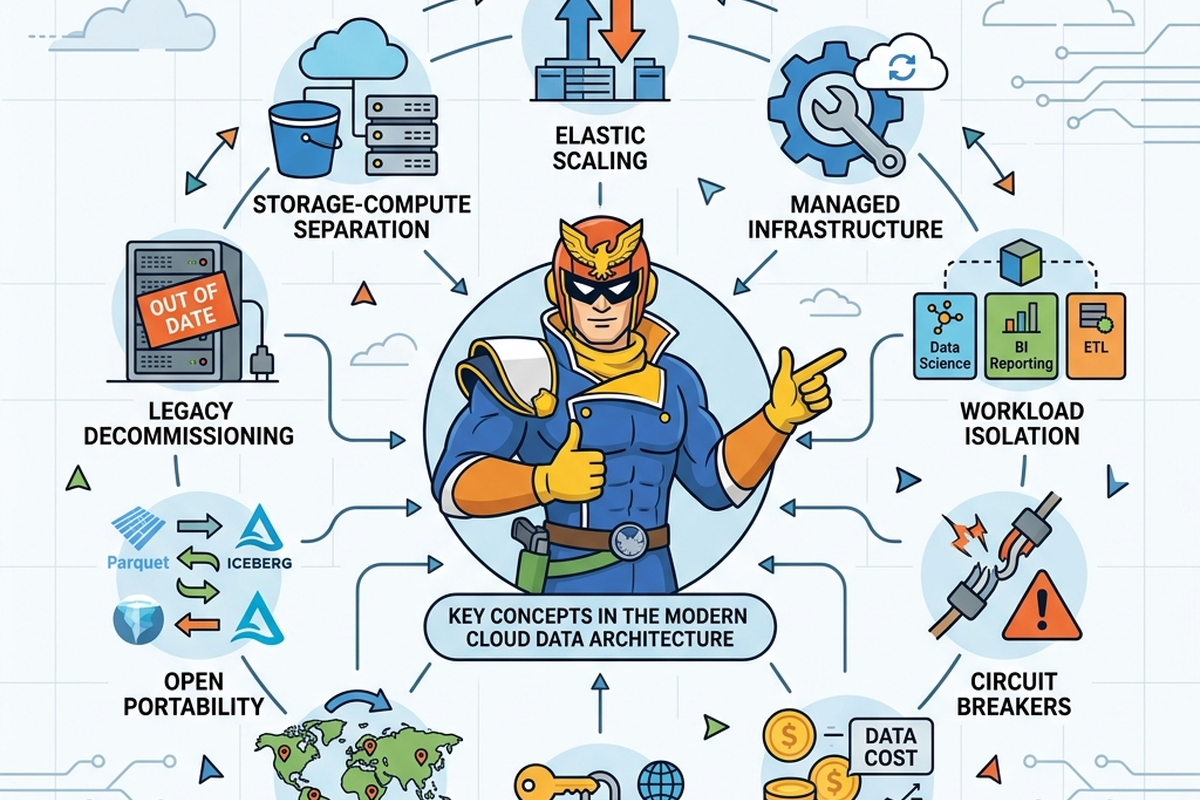
Picture the city now fully wired: storage and power metered separately, capacity scaling elastically with genuine demand, infrastructure maintained continuously by the utility itself, neighborhoods sharing the grid without interference, circuit breakers protecting against runaway draw, backup generators standing ready regardless, the grid reaching every building across the region, and building codes followed consistently throughout. Every piece this series has covered is now visible together, forming one genuinely well-run system.
In Plain English
A genuinely well-run cloud data warehouse practice, assembled from every piece this series has covered, combines storage-compute separation, elastic scaling configured to actually scale down, deliberate workload isolation and resource governance, granular cost attribution and observability, secure data sharing, thoughtful vendor selection weighing lock-in risk, ongoing governance responsibility, and deliberate, complete migration execution into one coordinated practice. No single piece makes a cloud data warehouse deployment genuinely well-run on its own — it’s the coordinated combination that does.
The Old Way
Before cloud data warehouses matured into this coordinated discipline with each of these pieces recognized individually, data warehouse operation looked meaningfully different:
- Organizations built and operated their own fixed-capacity infrastructure, guessing at future demand years in advance.
- Individual pieces now recognized as distinct disciplines — elastic scaling, cost attribution, workload isolation, governance — weren’t yet treated as separable, deliberately designed components.
- There wasn’t yet a well-established, coordinated architecture for combining genuinely elastic, managed infrastructure with deliberate cost, security, and governance discipline.
Seeing cloud data warehouses as a coordinated system of distinct, deliberately designed pieces — not just “the cloud version of the old warehouse” — is the accumulated, practical understanding this entire series has built article by article.
What’s Changing (and Why AI Is the Reason)
- Organizations increasingly combine elastic scaling, cost attribution, governance, and deliberate migration execution into one coordinated, production-grade cloud data warehouse practice.
- This connects directly across this content library’s entire Cloud & Modern Data Platforms category — cloud data warehouses are a foundational example of the broader cloud-native shift covered throughout this series’ companion series.
- As AI-driven analytical workloads continue to grow in scale and variability, the coordinated combination of every piece covered in this series is what separates a genuinely reliable, cost-effective deployment from an impressive but poorly managed one.
The Metaphor, Fully Extended
| The Utility Grid | Cloud Data Warehouse Practice (Fully Assembled) |
|---|---|
| Every system — metering, scaling, protection, governance — working together | Every practice — billing, scaling, governance, observability — working together |
| A city that runs reliably during both quiet nights and peak demand | A warehouse that runs reliably during both quiet periods and peak load |
| No single system making the whole grid trustworthy on its own | No single practice making the whole deployment trustworthy on its own |
| A fully coordinated grid, greater than the sum of its individual systems | A fully coordinated practice, greater than the sum of its individual pieces |
For Beginners: What to Actually Do
- Revisit this series’ earlier articles with the full picture in mind, noticing how billing, scaling, governance, and observability all connect into one coordinated whole.
- Practice applying the cost attribution and observability practices covered in Articles 13 and 18 to any cloud data warehouse you work with going forward.
- Get comfortable exploring this content library’s companion series on data warehousing and lakehouses, and this content library’s Cloud & Modern Data Platforms category more broadly.
For Practitioners and Leaders: The Deeper Layer
- Evaluate any cloud data warehouse deployment your organization runs against every piece covered in this series, not just its impressive initial migration.
- Invest deliberately in the less visible pieces — cost attribution, resource governance, ongoing decommissioning discipline — that separate genuinely well-run deployments from costly, poorly managed ones.
- Treat cloud data warehouse operation as a coordinated practice requiring sustained, deliberate organizational investment, not a one-time migration project.
Quick Recap
- A genuinely well-run cloud data warehouse combines elastic scaling, workload isolation, cost attribution, governance, and deliberate migration execution.
- No single piece makes a deployment genuinely well-run on its own — the coordination between pieces does.
- This connects directly across this content library’s entire Cloud & Modern Data Platforms category.
- The gap between an impressive migration and a genuinely well-run practice lies specifically in these coordinated, sustained practices.
Where This Fits in the Series
Article 20 closes this series by reassembling every piece covered across all twenty articles into one coordinated picture. From here, this content library’s dedicated lakehouse platforms series continues directly into a related architectural evolution: combining warehouse structure with data lake flexibility.
Key References
- Snowflake Documentation — Comprehensive technical documentation for cloud-native data warehousing.
- Google Cloud BigQuery Architecture Overview — Scalable serverless cloud database specifications.
- AWS Redshift Database Developer Guide — Amazon Web Services cloud data warehouse documentation.
Subscribe to the Newsletter
Get the latest DataParables articles delivered straight to your inbox.