
Opening Scene
A utility meter doesn’t just track one undifferentiated number. It separately measures electricity consumed, water used, and sometimes peak demand charges, because each represents a genuinely different kind of resource with its own cost structure. A cloud data warehouse’s billing works this same way: several genuinely distinct resources metered separately, and understanding each one is essential to using the platform well.
In Plain English
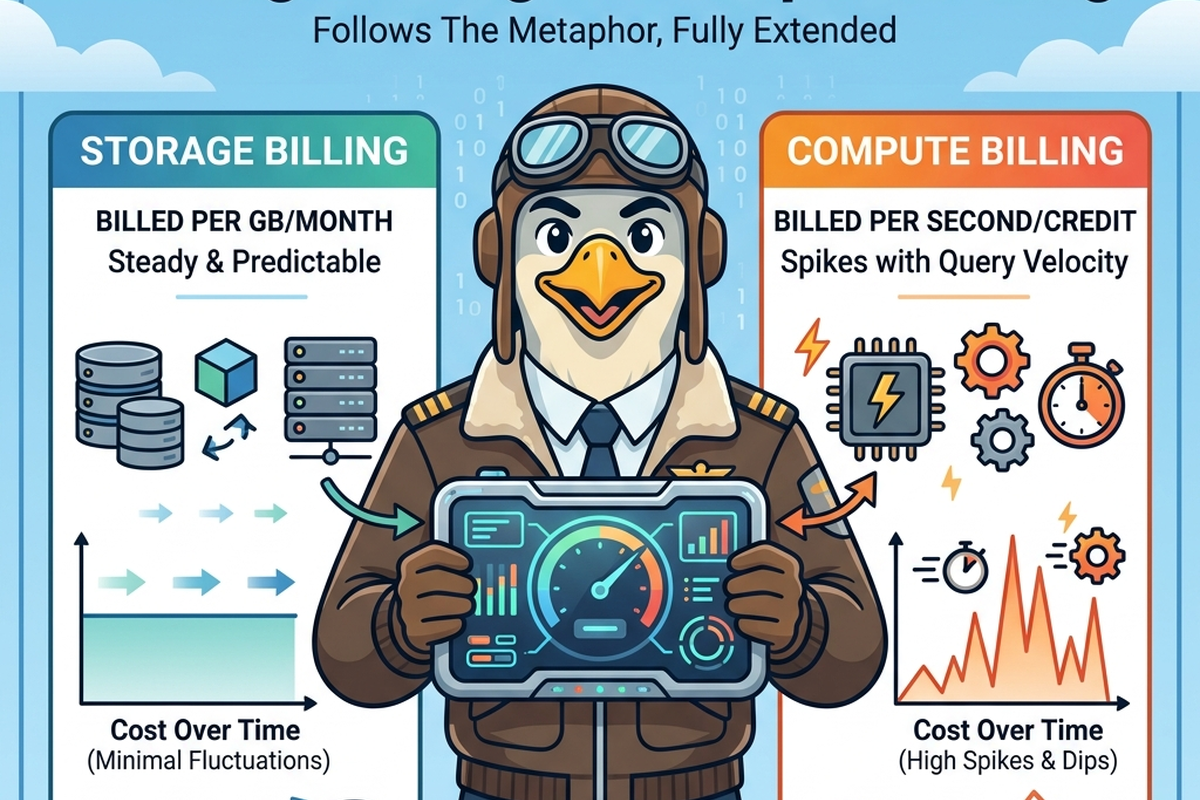
Cloud data warehouses typically meter storage (the actual data held, usually billed per gigabyte per month) and compute (the processing power used to run queries, usually billed per second or per credit consumed) as two genuinely separate resources, connecting directly to the storage-compute separation covered fully in Article 4. Understanding this split is essential, since storage costs tend to grow steadily and predictably, while compute costs can spike dramatically based on query patterns and usage discipline.
The Old Way
Before this metered, separated billing model was well understood by most practitioners, cost was often thought of as a single, undifferentiated number:
- On-premises warehouse costs were largely fixed and upfront, with no genuine distinction between storage and compute as separately variable cost drivers.
- Early cloud data warehouse users sometimes treated cost as a single, undifferentiated number, without understanding which specific usage patterns were actually driving it.
- There wasn’t yet a well-established practice of monitoring storage and compute costs separately to identify where genuine savings opportunities existed.
Understanding storage and compute as genuinely separate, differently behaving cost drivers reflects the accumulated practical experience of organizations that have used cloud data warehouses at real scale.
What’s Changing (and Why AI Is the Reason)
- Practitioners increasingly monitor storage and compute costs separately, connecting directly to the cost monitoring practices covered in this content library’s data platform cost and FinOps series.
- This connects directly to the elastic scaling covered in Article 5, since compute cost specifically is what makes scaling up and down for variable demand genuinely economical.
- As AI-driven analytics workloads grow, understanding this billing split has become increasingly important for accurately projecting and managing costs at scale.
The Metaphor, Fully Extended
| The Utility Meter | Cloud Data Warehouse Billing Concept |
|---|---|
| Electricity and water metered separately | Storage and compute metered separately |
| Each representing a genuinely different resource | Each behaving as a genuinely different cost driver |
| Steady baseline usage versus variable, spiking demand | Steady, predictable storage growth versus variable, spiking compute cost |
| Understanding each meter separately to use the utility well | Understanding each cost driver separately to use the platform well |
For Beginners: What to Actually Do
- Practice reviewing your organization’s cloud data warehouse bill, separating storage cost from compute cost explicitly.
- Learn to recognize which query patterns or workloads are driving compute costs specifically, as distinct from storage growth.
- Get comfortable exploring the cost monitoring practices covered in this content library’s data platform cost and FinOps series.
For Practitioners and Leaders: The Deeper Layer
- Require separate monitoring and attribution of storage and compute costs, connecting directly to this content library’s data platform cost and FinOps series.
- Recognize compute cost specifically as the primary lever for cost optimization, given its variability relative to steadier storage growth.
- Project costs explicitly at expected future scale, accounting for how storage and compute grow differently over time.
Quick Recap
- Cloud data warehouses meter storage and compute as two genuinely separate resources.
- Storage costs tend to grow steadily; compute costs can spike based on query patterns and usage discipline.
- Understanding this split is essential to managing cost effectively at scale.
- This connects directly to the cost monitoring practices covered in this content library’s dedicated FinOps series.
Where This Fits in the Series
Article 2 covered the metered billing model. Article 3 looks back at how organizations provisioned warehouse capacity before the grid existed at all.
Key References
- Snowflake Documentation — Comprehensive technical documentation for cloud-native data warehousing.
- Google Cloud BigQuery Architecture Overview — Scalable serverless cloud database specifications.
- AWS Redshift Database Developer Guide — Amazon Web Services cloud data warehouse documentation.
Subscribe to the Newsletter
Get the latest DataParables articles delivered straight to your inbox.