
Opening Scene
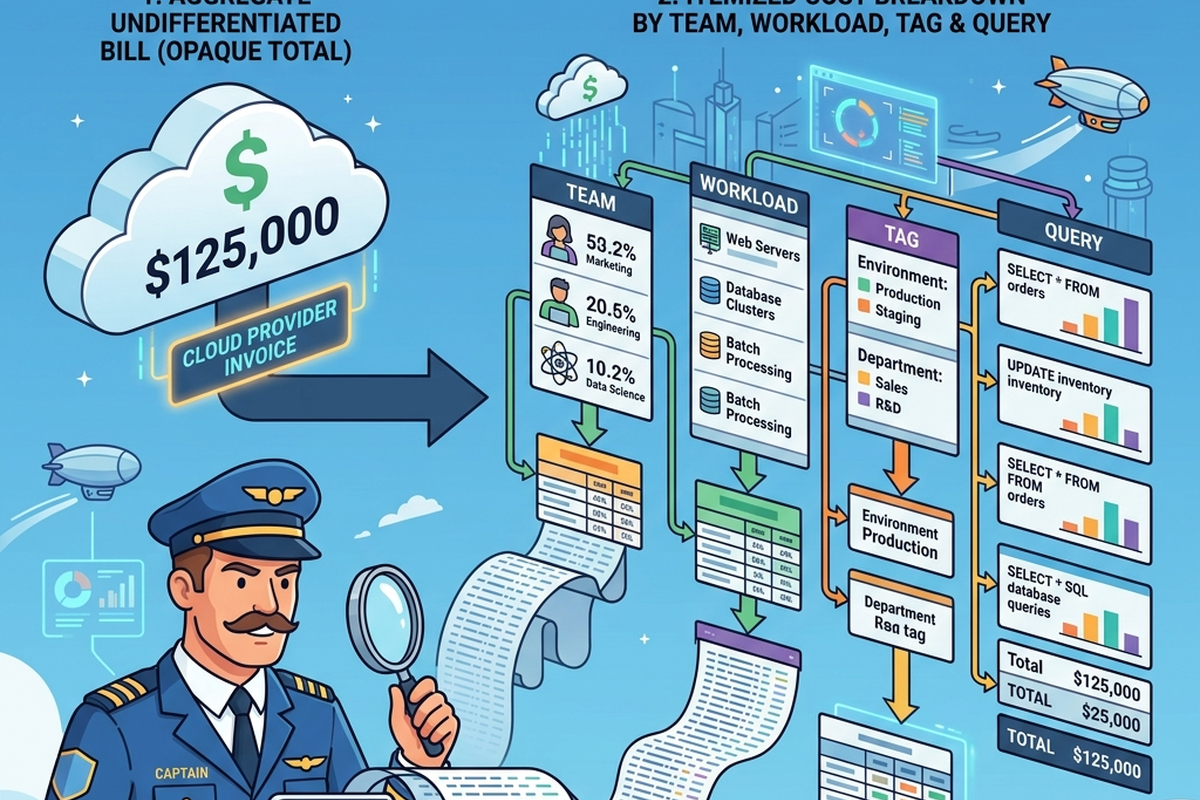
A shared utility bill for a large, multi-unit building is far more useful when it’s broken down by unit, rather than presented as one undifferentiated total. Only the itemized version lets you actually identify which unit is driving unusually high usage and address it directly. Cloud data warehouse cost deserves this same itemized breakdown: attributed to specific teams, workloads, and queries, not left as one undifferentiated total.
In Plain English
Cost attribution means tagging and tracking cloud data warehouse usage by team, project, or workload, so a rising bill can be traced to its actual, specific source rather than investigated as one opaque, aggregate number. This connects directly to the broader cost attribution practices covered in this content library’s dedicated data platform cost and FinOps series, applied here specifically to the storage and compute metering covered in Article 2.
The Old Way
Before granular cost attribution was standard practice, cloud data warehouse spend was sometimes tracked only in aggregate:
- Cloud data warehouse costs were sometimes tracked only as one aggregate total, without attribution to the specific teams or workloads actually driving that spend.
- There wasn’t yet a well-established practice of tagging queries or compute clusters specifically for cost attribution purposes.
- Identifying the actual source of an unexpected cost increase sometimes required time-consuming, manual investigation rather than immediate, tagged visibility.
Granular cost attribution, tagging usage specifically by team and workload, reflects the cost management discipline covered throughout this content library’s data platform cost and FinOps series.
What’s Changing (and Why AI Is the Reason)
- Organizations increasingly tag compute clusters and queries specifically for cost attribution, connecting directly to the cost management practices covered in this content library’s data platform cost and FinOps series.
- This connects directly to the workload isolation covered in Article 11, since isolated compute clusters per team naturally provide a clean, direct attribution boundary.
- As this practice matures, cost attribution dashboards increasingly become a standard, shared tool for accountability across teams sharing a platform.
The Metaphor, Fully Extended
| The Utility Grid | Cost Attribution Concept |
|---|---|
| An itemized, unit-by-unit bill versus one aggregate total | Cost attributed by team and workload versus one aggregate total |
| Identifying which unit is driving unusual usage directly | Identifying which team or workload is driving unusual spend directly |
| An itemized bill enabling direct, targeted action | Attributed cost data enabling direct, targeted action |
| Genuine visibility replacing an opaque, undifferentiated number | Genuine visibility replacing an opaque, undifferentiated cost total |
For Beginners: What to Actually Do
- Practice tagging a real or test compute cluster and query workload specifically for cost attribution purposes.
- Learn to trace a specific cost increase back to its actual source using attribution data, rather than guessing.
- Get comfortable exploring the cost management practices covered in this content library’s data platform cost and FinOps series.
For Practitioners and Leaders: The Deeper Layer
- Require granular cost attribution as a standard practice for any shared cloud data warehouse environment, connecting directly to this content library’s data platform cost and FinOps series.
- Use workload isolation, covered in Article 11, as a natural attribution boundary where practical.
- Build shared cost attribution dashboards as a standard accountability tool across teams sharing a platform.
Quick Recap
- Cost attribution tags and tracks cloud data warehouse usage by team, project, or workload.
- This connects directly to the cost management practices covered in this content library’s data platform cost and FinOps series.
- Attribution lets a rising cost be traced to its actual source, rather than investigated as an opaque total.
- Isolated compute clusters, covered in Article 11, provide a natural, clean attribution boundary.
Where This Fits in the Series
Article 13 covered cost attribution. Article 14 turns to bringing your own appliances: security and data sharing considerations within a cloud data warehouse.
Key References
- Snowflake Documentation — Comprehensive technical documentation for cloud-native data warehousing.
- Google Cloud BigQuery Architecture Overview — Scalable serverless cloud database specifications.
- AWS Redshift Database Developer Guide — Amazon Web Services cloud data warehouse documentation.
Subscribe to the Newsletter
Get the latest DataParables articles delivered straight to your inbox.