
Opening Scene
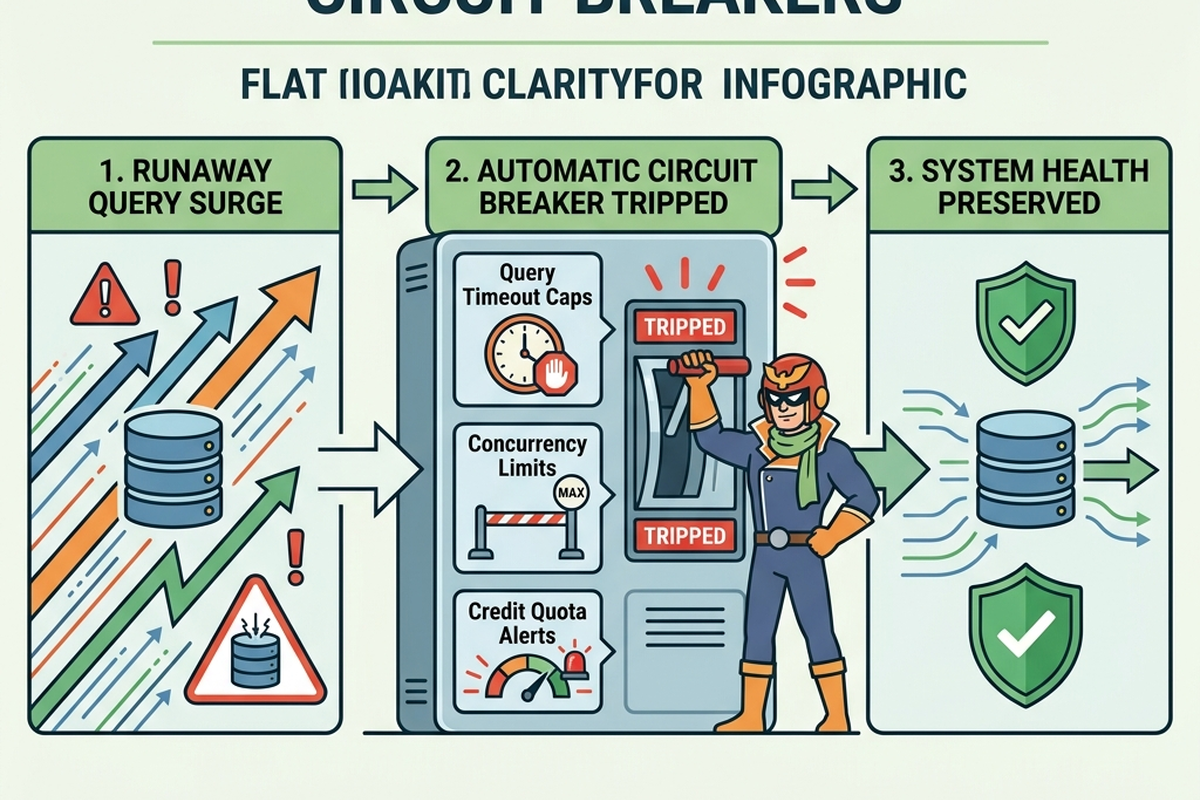
A circuit breaker exists specifically to protect an entire household’s electrical system from being damaged by one faulty appliance drawing excessive current — automatically cutting power before real harm occurs, rather than letting the problem cascade. A cloud data warehouse needs this same protective mechanism: resource governance controls that automatically limit or halt a runaway query before it degrades the system for everyone.
In Plain English
Resource governance sets deliberate limits — maximum query runtime, concurrency limits, resource consumption caps — that automatically protect a cloud data warehouse from being overwhelmed by a single poorly written query or an unexpected surge in concurrent usage. This connects directly to the workload isolation covered in Article 11, providing an additional layer of protection specifically within a shared compute cluster, where full isolation isn’t always practical or cost-effective.
The Old Way
Before deliberate resource governance was standard practice, a single problematic query could genuinely disrupt an entire shared warehouse environment:
- Without deliberate limits, a single poorly written or accidentally expensive query could consume disproportionate resources, degrading performance for every other user sharing that compute cluster.
- There wasn’t yet a well-established practice of setting automatic runtime and concurrency limits specifically to contain this risk.
- Problems were sometimes discovered only after they’d already significantly degraded performance for other users, rather than caught and contained automatically.
Deliberate, automatic resource governance emerged specifically to contain this risk before it cascades, much like a circuit breaker’s automatic, protective function.
What’s Changing (and Why AI Is the Reason)
- Cloud data warehouses increasingly support granular resource governance controls, connecting directly to the workload isolation covered in Article 11 as a complementary protection layer.
- This connects directly to the observability practices covered in Article 18, since identifying which specific queries or patterns need governance limits requires genuine query performance visibility.
- As AI-driven workloads introduce increasingly variable and sometimes unpredictable query patterns, resource governance has become genuinely more important as a protective safeguard.
The Metaphor, Fully Extended
| The Utility Grid | Resource Governance Concept |
|---|---|
| A circuit breaker protecting the household from a faulty appliance | Resource limits protecting the warehouse from a runaway query |
| Automatically cutting power before real harm occurs | Automatically halting or limiting a query before it degrades performance |
| Protecting the whole system, not just the faulty device | Protecting the whole shared environment, not just the problematic query |
| A deliberate, automatic protective mechanism | A deliberate, automatic protective governance control |
For Beginners: What to Actually Do
- Practice setting basic resource governance limits — maximum query runtime, concurrency caps — for a real or test cloud data warehouse environment.
- Learn to identify which specific queries or usage patterns in your organization might genuinely benefit from governance limits.
- Get comfortable exploring how your specific platform implements resource governance controls.
For Practitioners and Leaders: The Deeper Layer
- Require deliberate resource governance limits as a standard configuration for any shared cloud data warehouse environment.
- Connect resource governance directly to the workload isolation covered in Article 11 as complementary protection layers.
- Use query performance observability, covered in Article 18, to identify which specific patterns genuinely need governance limits.
Quick Recap
- Resource governance sets automatic limits protecting a shared cloud data warehouse from being overwhelmed by a single problematic query.
- This connects directly to the workload isolation covered in Article 11 as a complementary protection layer.
- This has become genuinely more important as AI-driven workloads introduce increasingly variable query patterns.
- Governance limits should be informed by genuine query performance observability.
Where This Fits in the Series
Article 12 covered resource governance controls. Article 13 turns to reading the bill line by line: cost monitoring and attribution specific to warehouse usage.
Key References
- Snowflake Documentation — Comprehensive technical documentation for cloud-native data warehousing.
- Google Cloud BigQuery Architecture Overview — Scalable serverless cloud database specifications.
- AWS Redshift Database Developer Guide — Amazon Web Services cloud data warehouse documentation.
Subscribe to the Newsletter
Get the latest DataParables articles delivered straight to your inbox.