
Opening Scene
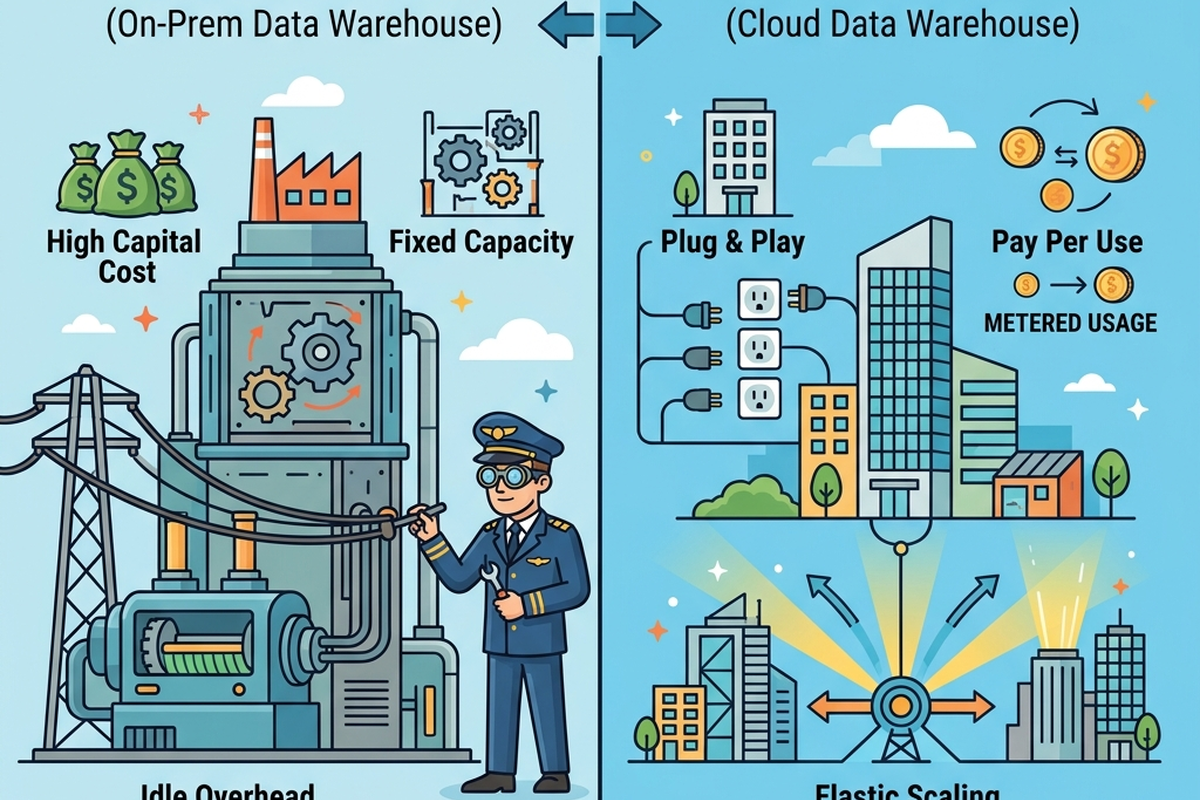
Before electrical grids existed, a factory that needed reliable power had to build and run its own generator — a genuinely significant capital investment, sized for peak demand, sitting partly idle most of the time. Plugging into a shared utility grid changed that completely: power on demand, paid for by what’s actually used, with no generator to build, run, or maintain. Cloud data warehouses offer this exact same shift for organizations that once had to build and run their own data warehouse infrastructure.
In Plain English
A cloud data warehouse is a fully managed data warehouse service — Snowflake, Google BigQuery, Amazon Redshift, and similar platforms — that provides storage and query compute as an on-demand, elastic service, rather than requiring an organization to purchase, size, and operate its own physical or virtualized warehouse infrastructure. This connects directly to the foundational warehousing concepts covered in this content library’s dedicated data warehousing and lakehouses series, extended here specifically to the cloud-native, utility-style delivery model.
The Old Way
Before cloud data warehouses existed as a mature, practical option, organizations had to build and operate their own warehouse infrastructure directly:
- Organizations had to purchase and size their own warehouse hardware upfront, guessing at future capacity needs years in advance, much like a factory sizing its own generator for a future it couldn’t fully predict.
- Scaling up for a busy period meant physically acquiring and provisioning more hardware, a slow, capital-intensive process with no way to scale back down easily once demand dropped.
- There wasn’t yet a well-established, elastic, pay-for-what-you-use model for data warehouse infrastructure specifically.
Cloud data warehouses emerged specifically to close this gap, applying the same utility-style, on-demand delivery model that had already transformed general computing infrastructure to the specific needs of data warehousing.
What’s Changing (and Why AI Is the Reason)
- Cloud data warehouses increasingly separate storage and compute as independently scalable, metered resources, covered fully in Article 4, fundamentally changing the underlying cost and capacity model.
- This connects directly to the broader cloud-native shift covered throughout this content library’s Cloud & Modern Data Platforms category, of which cloud data warehouses are a foundational, defining example.
- As AI and analytics workloads have grown increasingly variable and unpredictable, the elastic, on-demand model has become genuinely essential, not just a cost optimization, since fixed, pre-provisioned infrastructure struggles to keep pace with genuinely spiky, AI-driven query patterns.
The Metaphor, Fully Extended
| The Utility Grid | Cloud Data Warehouse Concept |
|---|---|
| Building and running your own power plant | Purchasing and operating your own warehouse infrastructure |
| Plugging into a shared grid, paying for what’s used | Using a managed cloud warehouse, paying for actual consumption |
| No generator to build, run, or maintain | No physical or virtualized warehouse infrastructure to operate |
| Power available on demand, at genuinely elastic scale | Compute and storage available on demand, at genuinely elastic scale |
For Beginners: What to Actually Do
- Practice comparing the provisioning process for an on-premises warehouse against a cloud data warehouse’s on-demand setup.
- Learn to recognize the basic value proposition: paying for actual usage rather than pre-purchased, fixed capacity.
- Get comfortable exploring this content library’s dedicated data warehousing and lakehouses series for the foundational warehousing concepts this series builds on.
For Practitioners and Leaders: The Deeper Layer
- Evaluate whether your organization’s current warehouse infrastructure still reflects the old, fixed-capacity model this shift was designed to replace.
- Recognize cloud data warehouses as a foundational example of the broader cloud-native shift covered throughout this content library’s Cloud & Modern Data Platforms category.
- Consider how increasingly variable, AI-driven query patterns make elastic, on-demand infrastructure genuinely necessary, not just cost-efficient.
Quick Recap
- Cloud data warehouses provide storage and query compute as a fully managed, on-demand service.
- This replaces the old model of purchasing, sizing, and operating physical or virtualized warehouse infrastructure directly.
- This connects directly to the foundational concepts covered in this content library’s data warehousing and lakehouses series.
- Elastic, on-demand infrastructure has become genuinely essential for increasingly variable, AI-driven workloads.
Where This Fits in the Series
Article 1 introduced the core shift cloud data warehouses represent. Article 2 looks more closely at what the meter actually measures: the specific billing model behind this shift.
Key References
- Snowflake Documentation — Comprehensive technical documentation for cloud-native data warehousing.
- Google Cloud BigQuery Architecture Overview — Scalable serverless cloud database specifications.
- AWS Redshift Database Developer Guide — Amazon Web Services cloud data warehouse documentation.
Subscribe to the Newsletter
Get the latest DataParables articles delivered straight to your inbox.