
Opening Scene
Think about moving into a new house and discovering it has central air conditioning for the first time. It’s wonderful — every room, perfectly comfortable, all the time. So you run it constantly, everywhere, without thinking much about it. Then the electricity bill arrives, and it’s not what anyone expected.
You didn’t do anything wrong, exactly. Central air is genuinely great. But it’s also a resource with a real, ongoing cost that scales with how much you use it — and “just leave it on everywhere, all the time” was never actually the plan, even if nobody said that out loud when you first turned it on.
That’s almost exactly the situation a lot of teams find themselves in after adding AI into their analytics architecture. Calling a model to classify, summarize, or enrich data is genuinely powerful — but it has a real, ongoing cost that scales with use, and “just call it everywhere, on everything” produces a bill nobody budgeted for. The fix isn’t to rip out the air conditioning. It’s to actually think about which rooms need it, and when.
In Plain English
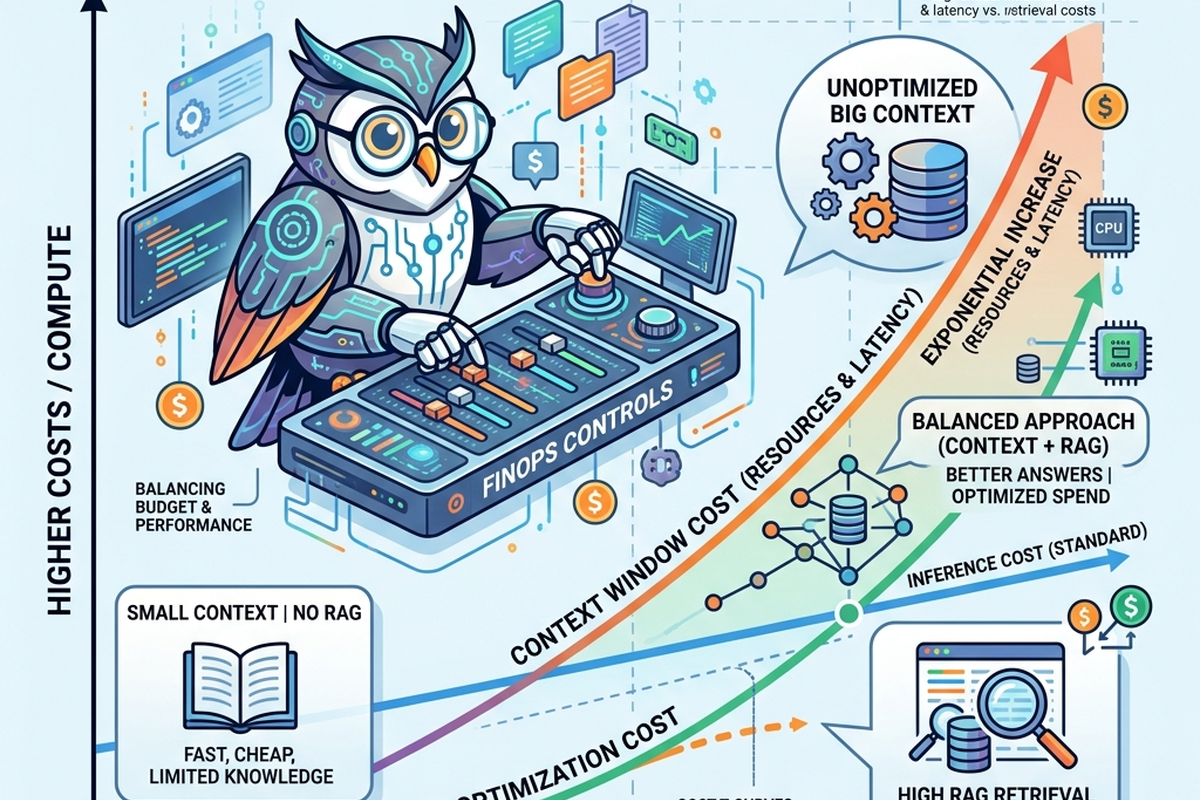
Every time an AI model processes something — a piece of text, a record, a question — it costs money and time, roughly in proportion to how much information you send it and how complex the task is. That cost is often called inference cost, and the amount of information you can usefully send a model at once is limited by something called a context window — think of it as the size of the room the AC has to cool, not infinite, and not free.
Architecting with AI means treating these costs the way you’d treat a real utility bill: budgeted deliberately, not just switched on everywhere by default.
The Old Way
In a traditional architecture, the cost conversation was mostly about storage and compute for deterministic processing:
- The electricity bill for lights and appliances is your traditional infrastructure cost: storage, basic compute, scheduled jobs — fairly predictable, scaling steadily with data volume.
- Turning on a light in a room you’re using is running a transformation job when you actually need the output — proportional, sensible, easy to reason about.
- Budgeting once a year for the obvious costs is the traditional infrastructure planning cycle — storage growth, compute scaling — well understood and slow-moving.
This worked because the costs were relatively linear and predictable: more data, more storage, roughly proportional compute. Nobody needed to think hard about whether running a transformation job was “worth it” — it almost always clearly was.
What’s Changing (and Why AI Is the Reason)
1. The new utility doesn’t scale the same way the old ones did. Calling an AI model isn’t like flipping a light switch with a fixed, tiny cost. Costs scale with how much text you send (the size of the “room”), how complex the task is, and how often you call it. Running it on every record, all the time, by default, is the equivalent of running central air in every room of the house, all day, regardless of whether anyone’s even home.
2. The context window is a real, physical-feeling constraint, not just a technical footnote. Just like a room has a physical size that limits how much air conditioning can actually cool it effectively, a model’s context window limits how much information it can usefully consider at once. Send too much, and either it gets cut off, or the model’s attention gets diluted across so much information that the quality of its output suffers — much like trying to cool an enormous open-plan space with a unit sized for one bedroom.
3. “More AI everywhere” stops being free reasoning and starts being a real budget line. Once a few augmentation steps (Article 3), a conversational BI layer (Article 5), and an orchestration layer calling models dynamically (Article 7) are all running in production, the cumulative inference cost becomes a real, trackable number — one that leadership will eventually ask about, the same way they’d ask about an electricity bill that doubled without anyone noticing why.
This is why architecting in the AI era means treating cost, compute, and context as trade-offs to design around deliberately — not externalities to discover later, in an invoice.
The Metaphor, Fully Extended
| The Household (Metaphor) | The Architecture (Technical) |
|---|---|
| The electricity bill for lights and appliances | Traditional infrastructure costs: storage and deterministic compute |
| Central air conditioning | AI model inference — powerful, but with a real, scaling cost |
| The size of a room the AC has to cool | The model’s context window — how much information it can usefully process at once |
| Running the AC in every room, all day, regardless of need | Calling an AI model on every record by default, regardless of whether it’s necessary |
| Cooling one room efficiently with the right-sized unit | A well-scoped, efficient use of AI on exactly the data that benefits from it |
| Trying to cool an enormous space with an undersized unit | Sending too much information into too small a context window, diluting output quality |
| A shocking electricity bill at the end of the month | An unexpectedly large inference cost discovered after AI features are already in production |
| Installing a smart thermostat that runs the AC only when and where needed | Caching, retrieval (RAG), and selective invocation strategies that call AI only when it adds real value |
For Beginners: What to Actually Do
- Get curious about what something actually costs, not just what it can do. When you see an AI-powered feature in a tool you use, ask (even just out of curiosity) whether it’s called on everything automatically or only when needed. This habit will make you a much sharper architecture thinker over time, even before you’re the one making these calls.
- Learn to recognize when a task doesn’t need AI at all. Not every classification or cleanup step needs a model — sometimes a simple rule does the job for a fraction of the cost, the same way a fan is sometimes genuinely all you need instead of central air. Knowing the difference is a real skill, not a lesser one.
- Notice when “more context” doesn’t actually help. If you’re working with a conversational AI tool and stuffing it with more and more information doesn’t seem to make answers better — sometimes the opposite — that’s the context-window dilution effect in action. It’s a good intuition to build early.
For Practitioners and Leaders: The Deeper Layer
- Make inference cost a visible, tracked metric, not a buried line item. Just as teams track storage growth and compute spend, track AI inference cost per pipeline, per feature, and ideally per business outcome — so trade-offs are visible decisions, not after-the-fact surprises.
- Use caching and retrieval (RAG) as architectural patterns, not just optimization tricks. Sending a model only the most relevant, pre-filtered context (retrieval) instead of everything available, and reusing previous results where appropriate (caching), is the architectural equivalent of a smart thermostat — meaningfully cutting cost without giving up the benefit.
- Decide explicitly where AI should NOT be used. This is an active design choice, not a failure of ambition. A simple deterministic rule that’s 95% as accurate at a fraction of the cost and latency is often the better engineering decision — reserve AI calls for the cases where judgment genuinely adds value over a rule.
- Treat the context window as a design constraint to architect around, not a limit to fight against. This means investing in good retrieval and summarization strategies upstream, so that what actually reaches the model is well-chosen and right-sized — the data equivalent of insulating a room properly before assuming you just need a bigger AC unit.
Quick Recap
- AI inference is a real, scaling cost — closer to a utility bill than a one-time infrastructure purchase.
- The context window is a genuine constraint, much like the size of a room an AC unit has to cool — overfilling it hurts quality, not just cost.
- Cumulative AI usage across multiple pipeline steps, conversational tools, and orchestration layers adds up to a real number that deserves visibility and tracking.
- Caching, retrieval (RAG), and selective invocation are the architectural equivalent of a smart thermostat — using AI only where and when it actually helps.
- Deciding where not to use AI is just as much an architecture decision as deciding where to use it.
Where This Fits in the Series
Article 7 looked at how an orchestration layer coordinates tools across the architecture; this article looked at the real, ongoing cost of doing so once AI is woven through that coordination, the pipelines (Article 3), and the conversational layer (Article 5). Next, in Article 9, we’ll shift from technical trade-offs to a more human one: how all of this ripples into the analytics team itself — new roles, shifting skill sets, and the people side of designing for an AI-augmented architecture.
Subscribe to the Newsletter
Get the latest DataParables articles delivered straight to your inbox.