Opening Scene
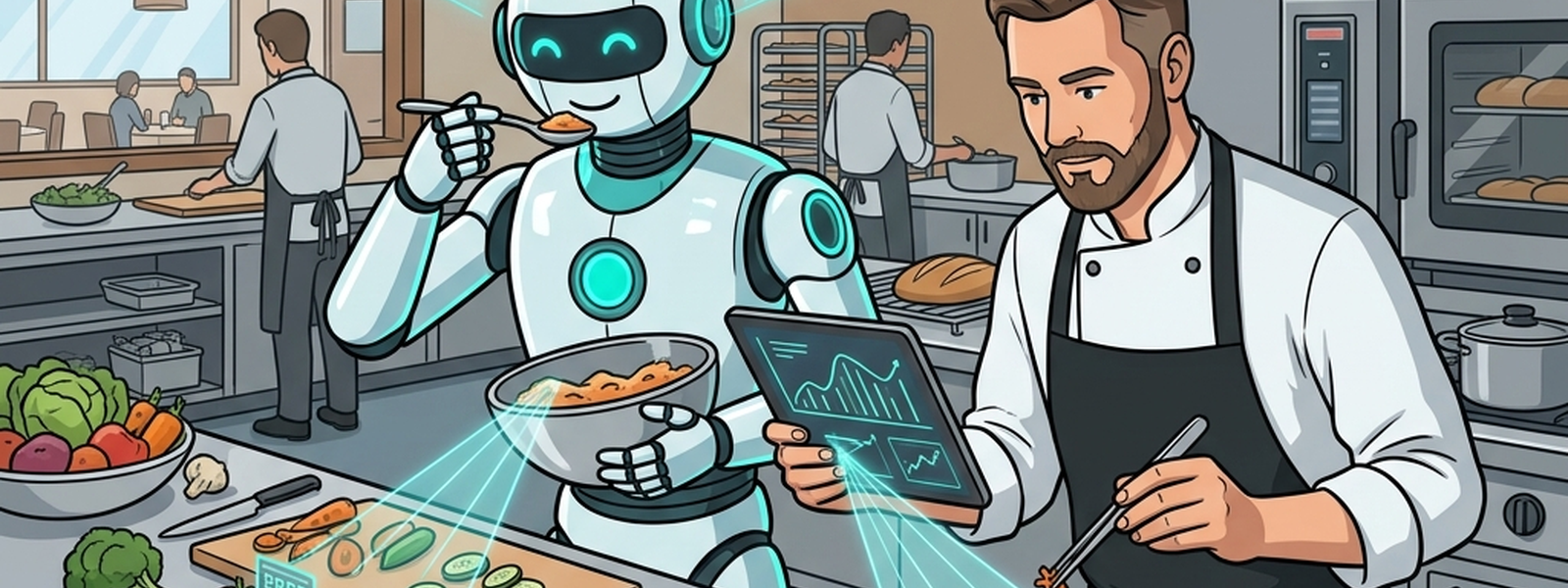
Picture a restaurant kitchen. Ingredients arrive at the back door — that’s the extract. A line cook washes, chops, and prepares them into something usable — that’s the transform. A server carries the finished plate out to the table — that’s the load. For decades, that’s been the whole job: get raw ingredients into a finished, edible dish, as reliably and repeatably as possible.
Now imagine a new figure steps into that kitchen: a sharp-eyed sous-chef who doesn’t just chop and prep, but tastes as they go, adjusts seasoning on the fly, flags a fish that smells slightly off before it reaches the pan, and jots a note on the ticket — “this batch of tomatoes is unusually sweet, adjust the sauce.” None of that was part of the old job. It’s not replacing the prep work; it’s happening alongside it, at almost every station in the kitchen.
That sous-chef is AI showing up inside your data pipeline. And the kitchen’s job description just got longer — from ETL to something more like ETA: Extract, Transform, Augment.
In Plain English
ETL (Extract, Transform, Load) is the classic recipe for moving data: pull it from a source, clean and reshape it, then load it somewhere useful, like a warehouse.
Augmentation is a new ingredient in that recipe: using AI during the pipeline to add things a simple cleaning step never could — classifying a customer complaint by sentiment, flagging an unusual transaction, summarizing a long text field, or filling in a missing detail using context instead of a hardcoded rule. It’s not a replacement for transform — it’s a new kind of seasoning happening at the same station.
The Old Way
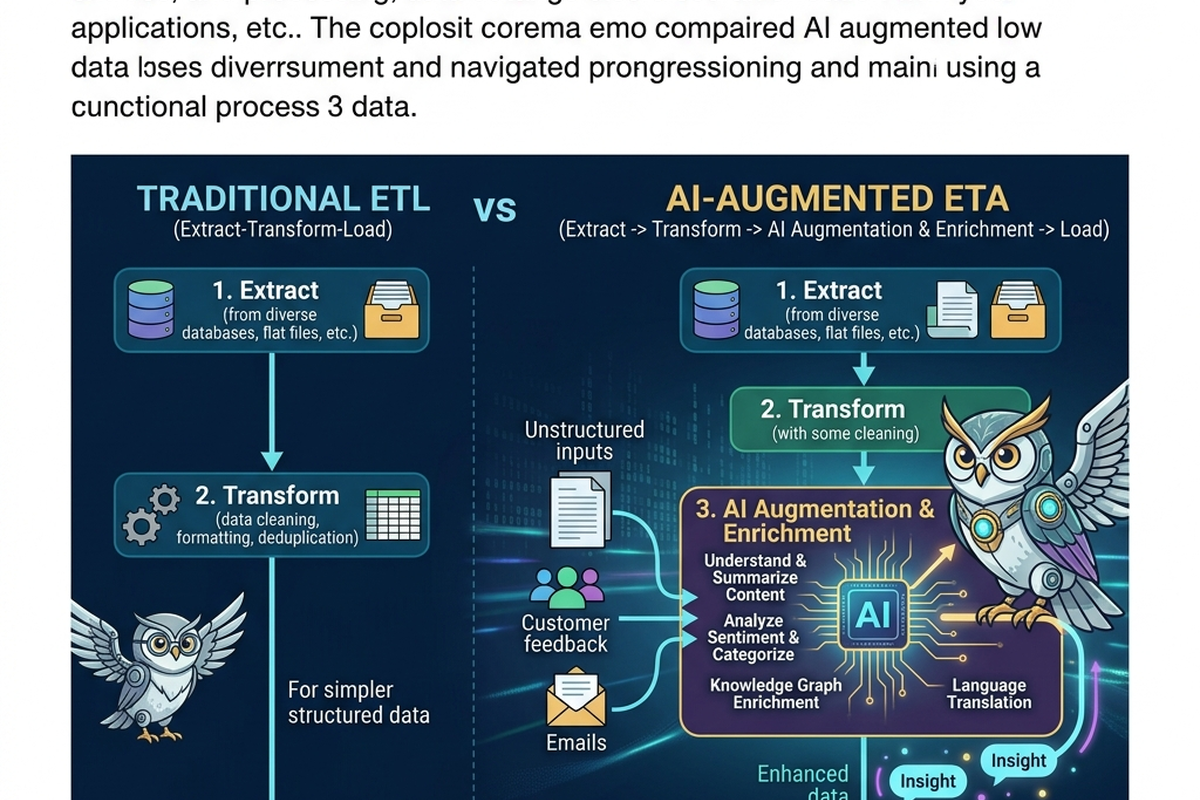
In a traditional pipeline, the kitchen has three clearly separated stations, and each one has a narrow, predictable job:
- Extract is the back-door delivery: pulling raw data from a source system, as-is, no judgment calls.
- Transform is the prep station: standardizing formats, fixing types, deduplicating, joining tables — all governed by explicit, deterministic rules a human engineer wrote in advance. If a rule wasn’t written down, the kitchen simply couldn’t do that step.
- Load is the server carrying the plate to the table: depositing the finished, cleaned data into the warehouse, ready to be consumed.
Every station does exactly what it’s told, nothing more. If a transaction looked weird, or a text field needed interpretation, that judgment call happened later — usually by a human analyst staring at a spreadsheet, long after the dish had already left the kitchen.
What’s Changing (and Why AI Is the Reason)
1. Judgment calls are moving earlier in the kitchen, not staying at the table. AI models can now do the kind of interpretive work that used to require a human looking at the final dish — classifying, summarizing, flagging anomalies — and they can do it during prep, not after serving. A customer review can be tagged with sentiment the moment it’s ingested, not weeks later in a report.
2. The sous-chef works at almost any station, not just one. Augmentation isn’t a single new step bolted onto the end of the line. It can happen right after extract (tagging raw data as it lands), in the middle of transform (enriching a record with context an AI model infers), or just before load (writing a generated summary alongside the raw fields). It’s less a fourth station and more a presence that can show up at any of the first three.
3. The recipe needs new quality checks, because taste is now partly a judgment call. A deterministic transform rule is easy to test: same input, same output, every time. An AI-driven augmentation step can vary — it might phrase a summary differently, or be slightly less confident on an edge case. The kitchen needs new ways to taste-test this kind of work, because “did it follow the rule” isn’t quite the right question anymore.
This is why the honest update to the old acronym is ETA: Extract, Transform, Augment — not because Load disappears, but because Augment is now woven in well before the dish ever reaches the table.
The Metaphor, Fully Extended
| The Kitchen (Metaphor) | The Architecture (Technical) |
|---|---|
| The back-door delivery | Extract — pulling raw data from source systems |
| The prep station | Transform — deterministic cleaning, reshaping, joining |
| The server carrying the plate | Load — depositing finished data into the warehouse |
| The sharp-eyed sous-chef | An AI model performing augmentation: classification, enrichment, summarization |
| Tasting and adjusting seasoning mid-prep | Inline AI enrichment happening during the transform step |
| Flagging a fish that smells off | AI-driven anomaly detection during ingestion |
| A note scribbled on the ticket | Metadata or a generated annotation attached to a record |
| A recipe card with exact, fixed steps | Deterministic transformation rules a human engineer defined in advance |
| The sous-chef’s judgment varying slightly batch to batch | The natural variability of AI-driven outputs, requiring new quality checks |
| A head chef tasting random plates before service | Human-in-the-loop validation of AI-augmented data before it’s trusted downstream |
For Beginners: What to Actually Do
- Get used to seeing AI steps inside pipelines, not just at the end. If you’re reading a pipeline’s documentation or code and see a step that calls a model to classify, summarize, or enrich data — that’s augmentation, and it’s increasingly normal, not exotic.
- Learn to ask “is this deterministic or AI-driven?” for any pipeline step. It’s a simple, powerful habit: deterministic steps will give the same output every time; augmented steps might not, and that changes how you debug something that looks “wrong.”
- Don’t assume an augmented field is wrong just because it’s not exact. An AI-generated sentiment tag or summary is supposed to involve some judgment — the goal is “reasonably useful,” not “bit-for-bit identical every run.” Learning to evaluate that kind of output is a new and valuable skill.
For Practitioners and Leaders: The Deeper Layer
- Design augmentation steps to be observable and explainable, not just functional. Because outputs can vary, you need logging that captures not just the result but enough context to understand why a model classified or flagged something a certain way — otherwise debugging becomes guesswork.
- Decide deliberately where augmentation happens in the pipeline, not by default. Augmenting early (closer to extract) means richer context downstream, but higher cost since every record gets processed; augmenting later (closer to load) is cheaper but may miss context only available earlier. This is a real architectural trade-off, not an implementation detail.
- Separate “facts” from “inferences” in your schema. A column populated by a deterministic transform and a column populated by an AI-generated inference are not the same kind of truth. Label them differently (e.g., a clear naming convention or a confidence-score field) so downstream consumers — human or AI — know which is which.
- Build a “taste test” step for augmentation, just like the old head chef sampling plates. This might be a human review queue for low-confidence AI outputs, a periodic audit sample, or automated checks comparing AI outputs against known-good answers. Augmentation without any quality loop is a kitchen with a sous-chef nobody is supervising.
Quick Recap
- Traditional ETL has three narrow, deterministic stations: Extract, Transform, Load.
- AI is adding a new kind of work — augmentation — that can happen at almost any station, not just as a final step.
- Augmentation involves judgment calls (classification, enrichment, summarization) that vary in a way deterministic rules never did.
- This variability means pipelines need new quality and observability practices, not just the old “did it follow the rule” testing.
- The honest update to the acronym is ETA: Extract, Transform, Augment — recognizing augmentation as a first-class, woven-in part of the pipeline, not an afterthought.
Where This Fits in the Series
Article 1 introduced the shift from a one-way data stack to a connected fabric, and Article 2 looked at how the data model itself needs to speak to a new kind of reader — AI. This article followed the data through the kitchen and showed how the cleaning and prep step is quietly absorbing a new kind of judgment-based work. Next, in Article 4, we’ll look at what happens when something in that kitchen needs to be questioned after the fact — governance and trust in an architecture where intelligence can act at almost any station, not just one.
Subscribe to the Newsletter
Get the latest DataParables articles delivered straight to your inbox.